


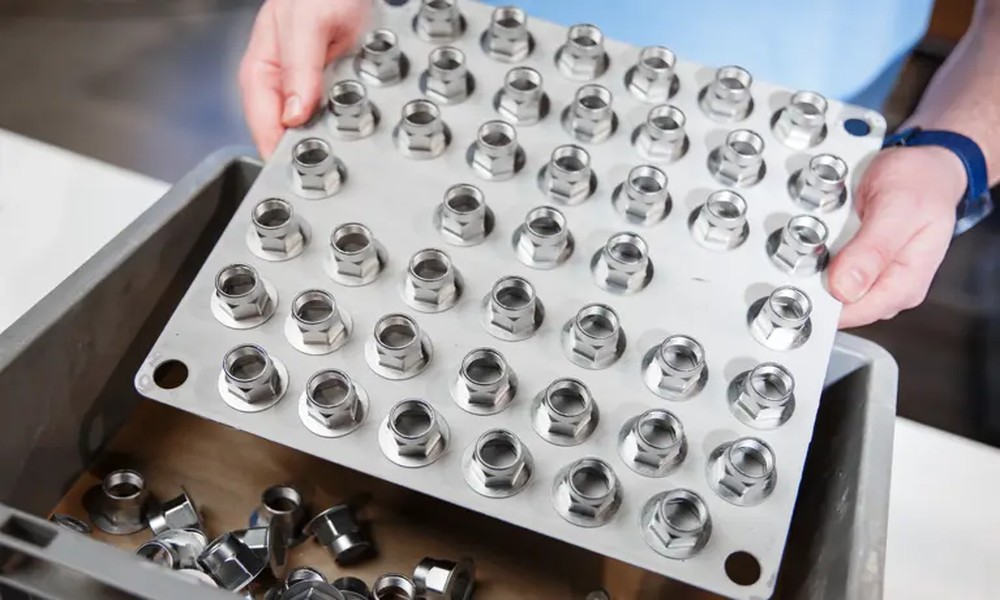
A MIM manufacturer uses metal injection moulding to produce small, complex metal components that conventional machining and casting methods struggle to deliver at competitive cost. The process merges fine metal powders with polymer binders, injects the mixture into precision moulds, removes the binder, and sinters the result into dense metal parts with mechanical properties comparable to wrought materials. Medical instruments, firearms components, electronic connectors, and automotive sensors all emerge from this production pathway.
How MIM Production Works
The MIM process follows four distinct stages. Feedstock preparation blends metal powder with a thermoplastic binder system at precise ratios, typically 60% metal by volume. The mixed feedstock loads into a standard injection moulding machine, which fills mould cavities under controlled pressure and temperature. The resulting “green part” holds its shape but remains fragile.
Debinding removes the polymer binder through solvent immersion, catalytic reaction, or thermal decomposition. The choice of debinding method depends on the binder chemistry and part geometry. Thick sections require longer debinding cycles to prevent cracking from gas evolution. The “brown part” that emerges contains only the metal powder skeleton held together by residual binder traces.
Sintering transforms the porous brown part into a dense metal component. Furnace temperatures reach 1,200 to 1,400 degrees Celsius depending on the alloy. The part shrinks by 15 to 22% in all directions as powder particles fuse together. Controlling this shrinkage to within 0.3% repeatability demands precise furnace atmosphere management and temperature profiling.
Alloy Selection and Properties
A capable MIM manufacturer maintains feedstock formulations across multiple alloy families. Stainless steels dominate medical and consumer applications. 316L provides corrosion resistance for implant and fluid-handling components. 17-4PH delivers high strength after precipitation hardening heat treatment.
Tool steels such as M2 and S7 serve applications requiring wear resistance. Titanium alloys address weight-critical aerospace components. Tungsten alloys produce high-density parts for radiation shielding and vibration damping. Each alloy carries unique sintering parameters, shrinkage factors, and post-sintering property targets that the manufacturer must validate through testing.
Tolerances and Surface Finish
MIM achieves dimensional tolerances of plus or minus 0.3% of nominal dimensions in the sintered state. Secondary machining tightens critical features to plus or minus 0.01mm where required. Surface roughness ranges from 0.8 to 1.6 microns Ra, adequate for many functional surfaces without additional finishing.
Parts requiring tighter surface specifications undergo tumble polishing, vibratory finishing, or electropolishing. Medical components contacting tissue or blood often require electropolished surfaces below 0.4 microns Ra to minimise protein adhesion and bacterial colonisation.
Design Considerations for MIM Parts
Designing for MIM production requires understanding the constraints imposed by each process stage. Wall thickness between 0.5mm and 6mm ensures complete debinding without excessive cycle times. Gradual transitions between thick and thin sections prevent differential shrinkage during sintering.
- Minimum hole diameter sits at 0.5mm, with depth-to-diameter ratios limited to 6:1 without secondary drilling
- Internal threads are moulded directly when pitch exceeds 0.5mm, eliminating tapping operations
- Undercuts require side cores or collapsible tooling, adding mould cost but enabling geometries impossible in die casting
- Flat surfaces larger than 15mm benefit from subtle texturing to mask minor sintering-induced waviness
“Singapore’s MIM sector has carved a position in high-precision medical and electronics components, leveraging the nation’s strengths in precision engineering and quality infrastructure,” observed Professor Tor Shu Beng, from the School of Mechanical and Aerospace Engineering at Nanyang Technological University.
Quality Assurance in MIM Production
Dimensional inspection of sintered parts uses coordinate measuring machines and optical comparators. Density measurements via Archimedes method confirm sintering completeness. Metallographic analysis of polished cross-sections verifies microstructure, grain size, and porosity levels below 2% for standard applications.
Metal injection moulding specialists implement statistical process control across injection, debinding, and sintering stages. Control charts track shot weight, debinding weight loss, and sintered dimensions against validated specification limits. Out-of-control conditions halt production pending investigation.
Mechanical testing per ASTM or ISO standards validates tensile strength, elongation, hardness, and fatigue life for each alloy and heat treatment combination. Test specimens moulded alongside production parts ensure that reported properties reflect actual production conditions.
Cost Drivers and Economic Considerations
Tooling investment represents the primary upfront cost in MIM production. Single-cavity prototype moulds start at SGD 10,000. Multi-cavity production moulds for high-volume parts reach SGD 60,000 to SGD 100,000. Mould life spans 200,000 to 500,000 shots depending on material abrasiveness and part complexity.
Per-part costs decrease as volume increases because tooling amortisation spreads across more units. At volumes above 10,000 parts annually, MIM competes with and often undercuts CNC machining for complex geometries. The break-even analysis depends on part weight, alloy cost, secondary operations, and inspection requirements.
Choosing the Right MIM Production Partner
Selecting a MIM manufacturer requires evaluating sintering furnace capabilities, alloy experience, and quality certifications relevant to your market. Request sample parts in your target alloy to assess dimensional accuracy and surface quality. Review process validation records for the specific alloy and geometry class matching your component. Manufacturers with in-house mould design and secondary machining capabilities reduce lead times and communication overhead. The strongest MIM manufacturer relationships develop through early design collaboration, where moulding expertise shapes the component geometry for optimal production outcomes.
